Inaugural Lecture: Professor David Owens, Sekyra and White's Professor of Moral Philosophy
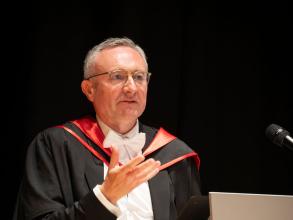
Photography by Keiko Ikeuchi
David Owens' inaugural lecture took place on Wednesday 20 May 2026.
In his inaugural lecture, David Owens considered how philosophers have developed theories of justice to identify the values that should guide collective decision-making. Liberal egalitarians such as John Rawls, for example, argue that liberty, equality, democracy and scientific knowledge are the political values that define a just society.
Owens argued that there can be no philosophical theory of justice because the values that make up any plausible conception of justice are mutually independent. Rather than being united by an internal philosophical logic, these values derive their collective importance from contingent socio-historical circumstances that enable communities to coalesce around them. He called this the fragmentation of justice.
The lecture also considered the common belief that human history ought to move in a particular direction, defined by a shared conception of justice. While the 1990s appeared to many to mark an historical trajectory towards liberal democracy, Owens suggested that both the philosophical and historical assumptions underlying this optimism should be questioned. Does political morality really point all of humanity towards a single destination? Drawing on the fragmentation of justice, he instead sketched a non-progressive understanding of human history.
A recording of the lecture is available here.